


Around NOV Lernatun
Surrounded by the natural beauty of Syunik, the village lies near the Vorotan and Lori rivers and just 1 km from the serene Shamb Reservoir. NOV Lernatun is embraced by the forested mountains of Novak, offering peaceful landscapes and panoramic views of Shamb, Ishkhanasar, the Vorotan Valley, and the Lori Canyon.
 |  |  |  |
|---|---|---|---|
 |  |  |  |
 |  |  |  |
 |  |  |  |
 |
VOROTNAVANQ
Vorotnavank is a remarkable example of medieval Armenian architecture and one of the most important religious and cultural centers of the 10th–15th centuries. Located just 7 km west of Ltsen, it stands on the right bank of the dramatic Vorotan Canyon, surrounded by the powerful landscape of Syunik.
The monastery’s oldest structure is the Church of Surb Stepanos, built in the year 1000 by Shahandukht of the Bagratuni dynasty, the Queen of Syunik. Once protected by high defensive walls, the complex included workshops, storage rooms, a seminary, a retreat area, and an alms-house.
Vorotnavank is also closely linked to Hovhannes Vorotnetsi (1315–1398), a distinguished medieval Armenian philosopher and the founder of the Tatev University (Tatev Vardapetaran), who lived and worked here.
VOROTNBERD FORTRESS
Vorotnaberd is a historic fortress perched along a ridge overlooking the dramatic Vorotan Gorge, between the villages of Vaghatin and Vorotan in Syunik Province. Rising 1,365 meters above sea level, the fortress offers breathtaking views and a glimpse into the region’s rich medieval history.
MELIK TANGI BRIDGE
Located 6 kilometers east of Ltsen near the village of Vorotanavan, Melik Tangi Bridge gracefully spans the Vorotan River. Built in 1853 by Melik Tangi, the ruler of the Sisian district, the bridge is a testament to the region’s architectural heritage. Nearby, visitors can enjoy a natural mineral water thermal pool, warmed to a soothing 37°C, offering a perfect blend of history and relaxation.
AGHITU MONUMENT
Located 15 kilometers west of Ltsen in the village of Aghitu, this historic monument dates back to the 6th century. It is believed to have been commissioned by Princess Varazdukht to commemorate an important event in Syunik’s history.
On the eastern wall, above the top of a pillar, a timeworn carving reveals the face of the queen, connecting visitors to the monument’s storied past. The second floor once served as a stage for performances and religious rituals, while the remains of an ancient church stand nearby. Today, only portions of the stage and the northern wall remain, offering a glimpse into the monument’s historical significance.
SHAKEH WATERFALL
One of Armenia’s natural treasures, Shakeh Waterfall cascades 18 meters into the pristine waters of the Shakeh tributary of the Vorotan River, just 3 kilometers northwest of Sisian. Fed by pure underground springs, the waterfall and its surrounding landscape create a serene retreat, perfect for escaping the summer heat and enjoying the beauty of Syunik’s nature.
KOTRATS CARAVANSERAI
"Kotrats Caravansaray,"* built in 1319 by the Orbelian family as a way point on the Silk Road. The Armenian inscription over the door is badly weathered, but a Persian inscription survives above it. There are also standing stones of an early Iron Age cemetery nearby. An Aramaic inscription was found nearby. Beyond Harzhis, a rough dirt road continues to Shinuhayr, passing remains of a medieval hamlet on the edge of the gorge. There are castle remains somewhere nearby. Deep inside the gorge below Harzhis is a 13th c. bridge over the Vorotan.
KHNDZORESK
Khndzoresk is renowned for its canyon, striking rock formations, and ancient cave settlement. Many of the artificial caves, some still used as stables and storage, were inhabited until the 1950s, offering a fascinating glimpse into the region’s past.
At the bottom of the gorge stands St. Hripsime Church, dating to the 17th century. On a nearby spur lies Anapat, the hermitage, where the tomb of Mkhitar Sparapet is located. The cave church of St. Tatevos is also found within this remarkable landscape, making Khndzoresk a unique blend of natural beauty and historical heritage.
TATEV MONASTERY
Tatev Monastery, a 9th-century Armenian Apostolic complex, is located 15 km from Ltsen in Syunik Province. Perched on the edge of the deep Vorotan Gorge, Tatev has long been a center of spiritual, cultural, and political life in the region.
In the 14th and 15th centuries, the monastery was home to the renowned University of Tatev, one of medieval Armenia’s most important centers of learning. Scholars here advanced science, philosophy, and theology, and preserved Armenian culture through manuscript reproduction and the art of miniature painting, even during turbulent times.
Today, Tatev remains the most iconic site in Syunik. Visitors can also experience the Wings of Tatev, a cableway connecting Tatev to Halidzor village, which opened in 2010 and holds the Guinness World Record as the world’s longest non-stop double-track cable car.
ARZUMAN BRIDGE
Located just 1 kilometer from Ltsen, along the hiking route to Darbas, Arzuman Bridge spans the Lori River. Built by the Arzuman family, this historic structure was once part of one of the Silk Road routes, serving as an important link in the region’s cultural and commercial network.
WINGS OF TATEV
Located near the historic 9th-century Tatev Monastery, perched on the edge of the Vorotan Gorge, the Wings of Tatev cableway beautifully blends heritage and modern innovation. Opened on October 16, 2010, it provides visitors with a breathtaking journey over the dramatic landscape of Syunik.
Just a week later, on October 23, 2010, the cableway was recognized by the Guinness World Records as the world’s longest reversible aerial tramway. Stretching 5,752 meters, it set records not only for its length but also for the speed of its construction, completed in just 10 months, connecting visitors to both the historical and the contemporary treasures of the region.
QARAHOUNGE
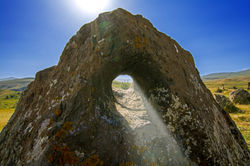
Qarahounge, also known as Zorats Karer, is a prehistoric archaeological site near the town of Sisian in Syunik Province. Often referred to as the “Armenian Stonehenge,” it consists of hundreds of vertically positioned stones, some of which are believed to have been used for astronomical observations.
The site reflects the ingenuity, knowledge, and spiritual life of Armenia’s ancient people.
UXTASAR
Ukhtasar lies about 25 km north of Ltsen, in the heart of the Syunik Highlands, between Black and Al Lakes, at an elevation of 3,300 meters above sea level. The route to this ancient site is challenging, typically accessible only between June and September.
The rock carvings at Ukhtasar, created by Armenia’s early ancestors between the 5th and 2nd millennia B.C., are etched onto more than a thousand stones and depict scenes of hunting, daily life, and worship. These remarkable petroglyphs are of global significance, offering insight into the cultural origins and early symbolism of the Armenian people. Today, Ukhtasar remains one of Syunik’s most awe-inspiring and unforgettable destinations.
ANAPAT CHAPEL
Anapat Chapel, also known as Surb Khach (Saint Cross), was built in 1347 on the territory of the village of Ltsen, on the slopes of Novak Mountain. This historic chapel stands as a testament to the region’s medieval spiritual heritage and offers visitors a serene and contemplative experience amid Syunik’s natural beauty.
 |  |  |  |
|---|---|---|---|
 |  | |  |
|  |
How to go


NOV Lernatun Team
Wellcome!